

Pro SEO Company for Advanced Crawling Strategies
Sep 26, 2026


Search engine optimization is no longer limited to adding keywords, publishing blog posts, and building backlinks. Your website must now satisfy users, search engines, AI-powered search systems, and local audiences at the same time. This is why choosing the right SEO partner can have a major impact on your online visibility, qualified traffic, and long-term growth.
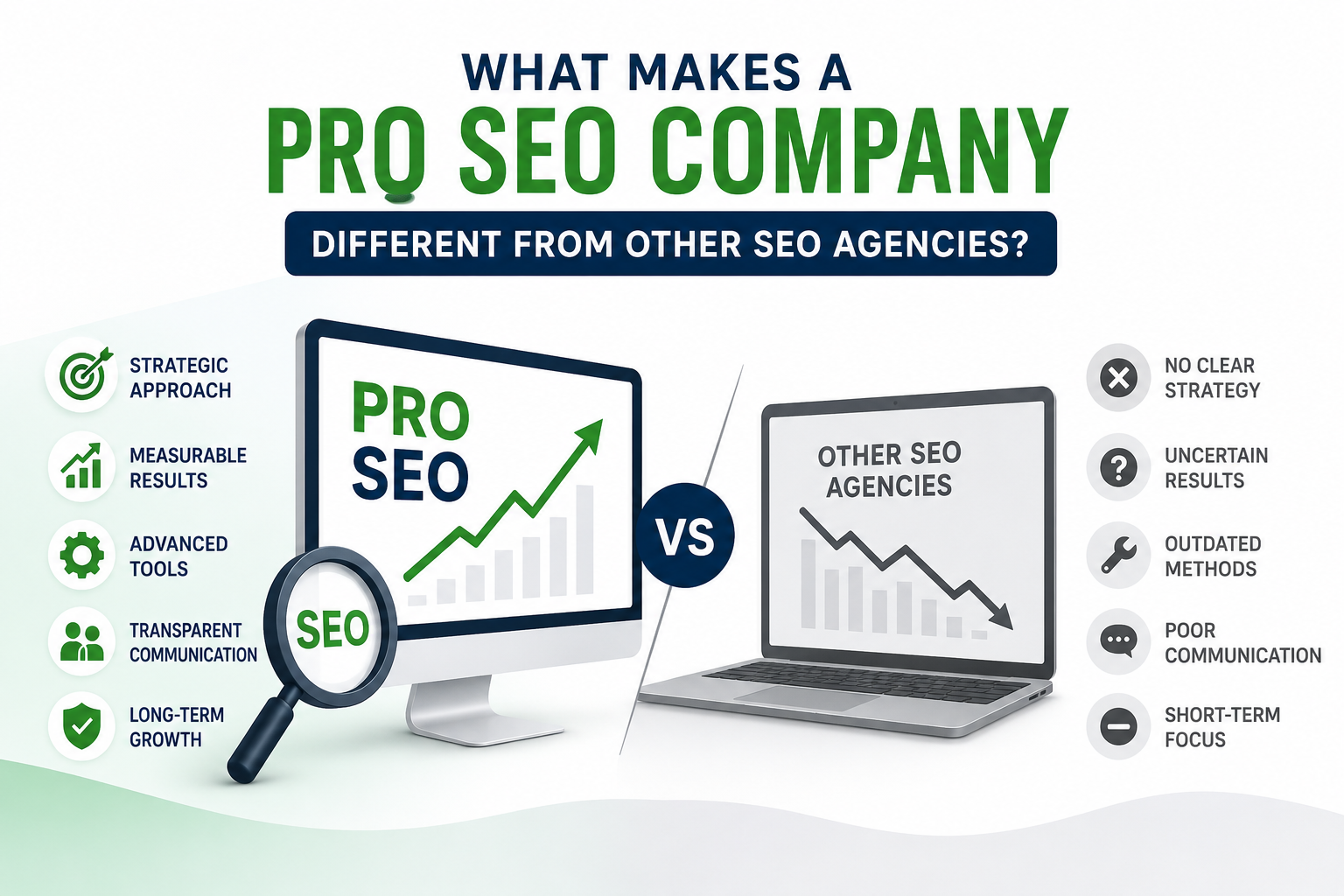
A PRO SEO Company takes a broader and more strategic approach than an agency that focuses mainly on individual SEO tasks. Instead of treating SEO as a collection of disconnected activities, you get a structured strategy that connects technical performance, useful content, search intent, authority, local visibility, and measurable business outcomes.
A PRO SEO Company is an SEO partner that focuses on developing a complete search visibility strategy around your business goals. It looks beyond rankings and considers how your website attracts visitors, answers their questions, earns trust, generates leads, and supports conversions.
You can expect a professional SEO approach to examine areas such as:
The key difference is integration. Each activity supports the others instead of operating as an isolated campaign.
Many SEO agencies begin with a standard checklist. You may receive keyword research, technical recommendations, content production, and backlink campaigns without a clear connection to your business objectives.
A more professional approach starts with your goals.
If you want more local customers, your strategy should prioritize local search visibility, Google Business Profile optimization, location-focused content, reviews, citations, and locally relevant authority.
If you operate an e-commerce website, your priorities may include product-page optimization, category architecture, transactional keywords, technical crawlability, and conversion improvements.
You should therefore expect your SEO strategy to reflect your industry, competition, audience, location, services, and revenue objectives.
Your content cannot perform consistently if search engines struggle to crawl, understand, or index your website.
A professional SEO team examines technical factors such as:
Rather than fixing technical problems once and forgetting them, you should monitor your website continuously. New pages, redesigns, plugins, migrations, and development changes can create SEO issues over time.
Simply inserting a keyword into an article is not enough to compete effectively.
A professional SEO strategy asks what the searcher actually wants to accomplish. Someone searching for “SEO company” may be researching providers, while someone searching for “SEO pricing” may be comparing costs. Someone searching for “SEO agency near me” has a strong local intent.
Your content should address the specific need behind each search.
You can improve content quality by:
This approach makes your content more useful to people and easier for search systems to interpret.
Another important difference is the way content is organized.
Instead of publishing unrelated articles whenever a keyword looks attractive, a professional SEO strategy can build topic clusters. You create a comprehensive pillar page around a broad subject and connect it to supporting pages that answer narrower questions.
For example, an SEO website could build a cluster around technical SEO that includes:
Strong internal linking helps users discover related information while giving search engines clearer signals about the relationship between your pages.
Search behavior is becoming increasingly conversational. People now ask detailed questions through AI-powered search experiences rather than relying only on traditional keyword searches.
Your content should therefore be structured so that important information can be understood and extracted easily.
An AI-, AEO-, and GEO-focused approach can include:
Answer Engine Optimization (AEO) focuses on making your content useful for direct-answer experiences, while Generative Engine Optimization (GEO) considers visibility within generative and AI-driven search environments.
You should not abandon traditional SEO. Instead, you should build a strategy that supports multiple search experiences.
If your business serves a specific geographic area, local SEO can be one of your most valuable growth channels.
A professional local SEO strategy can optimize your website and online presence around geographic relevance. This may include location pages, local keyword research, Google Business Profile optimization, consistent business information, customer reviews, local citations, and locally relevant content.
For example, a business serving multiple cities should avoid creating thin pages that simply replace one city name with another. Each location page should provide genuinely useful information about the services, customers, areas served, and local context.
That gives you a stronger opportunity to demonstrate relevance to both users and local search systems.
Your visitors need a reason to trust your business before they contact you or make a purchase.
A professional SEO strategy considers Experience, Expertise, Authoritativeness, and Trustworthiness (E-E-A-T). You can strengthen these signals by demonstrating who creates your content, showcasing relevant experience, maintaining accurate business information, publishing useful resources, earning reputable mentions, and providing transparent company information.
Trust should not be treated as a marketing slogan. Your website should demonstrate it through the information and experience you provide.
SEO decisions should be supported by evidence rather than assumptions.
A strong SEO campaign uses performance data to determine what is working and what needs improvement. You can monitor metrics such as:
However, rankings should not be your only measurement. A keyword moving from position 20 to position 10 may look impressive, but the more important question is whether that visibility brings relevant visitors and business opportunities.
SEO reports should help you understand what happened, why it happened, and what should happen next.
Instead of overwhelming you with hundreds of metrics, useful reporting highlights meaningful changes and connects SEO activity with business objectives.
You should be able to understand:
Clear communication makes it easier for you to evaluate progress and make informed decisions.
Backlinks can still contribute to authority, but quality matters more than simply collecting large numbers of links.
A professional approach focuses on earning relevant and credible mentions through useful content, digital PR, industry relationships, valuable resources, and legitimate outreach.
You should be cautious of strategies promising hundreds of backlinks in a short period. Artificial or irrelevant links can create unnecessary risk and rarely provide the same value as authoritative, contextually relevant references.
Getting visitors to your website is only part of the job.
Once users arrive, they should be able to understand your offer and take the next appropriate action. Your SEO strategy should therefore consider calls to action, page structure, navigation, service information, forms, trust signals, and mobile usability.
For example, a service page can attract strong organic traffic but still generate few leads if its value proposition is unclear or its contact process is difficult.
SEO and conversion optimization work best when they support the same goal: turning relevant search visibility into meaningful business results.
Before selecting an SEO agency, ask practical questions about its process.
Find out how the agency performs technical audits, researches search intent, develops content, handles local SEO, evaluates backlinks, measures conversions, and reports results.
You should also ask whether the team can explain its recommendations clearly. If you cannot understand why a specific SEO activity matters to your business, you may struggle to evaluate its value.
Look for a partner that emphasizes sustainable improvements rather than unrealistic ranking guarantees.
The biggest difference is not necessarily the number of services an SEO company offers. It is how those services work together.
You need technical SEO to make your website accessible. You need useful content to satisfy search intent. You need authority and trust to strengthen credibility. You need local optimization when geographic relevance matters. You need structured information for modern search systems. And you need measurement to understand whether your investment is producing meaningful results.
A professional SEO strategy connects these elements into one clear process.
If you want to improve organic visibility, attract more qualified visitors, strengthen local search performance, and prepare your website for evolving AI search experiences, start with a strategy based on your actual business objectives.
When you are ready to discuss your goals, use the SEO consultation and Contact Us page to take the next step.
A PRO SEO Company typically takes a more integrated approach. It connects technical SEO, content, search intent, local optimization, authority, AI search readiness, conversion optimization, and performance tracking rather than treating each activity as a separate task.
No. Rankings are useful, but they are not the only objective. A strong SEO strategy also considers qualified traffic, leads, conversions, local visibility, user experience, brand authority, and visibility across modern AI-powered search experiences.
Local SEO helps you reach people searching for products or services in specific geographic areas. Optimizing location pages, business information, reviews, local content, and relevant search signals can improve your ability to connect with nearby customers.
AI search increases the importance of clear, trustworthy, well-structured information. You should create content that directly answers questions, demonstrates expertise, explains entities and relationships clearly, and provides useful information that can support both traditional and generative search experiences.
SEO timelines vary according to competition, website condition, authority, industry, content quality, and the scope of optimization. You may see early improvements within months, while stronger and more sustainable results generally require consistent work over a longer period.