

Pro SEO Company for Advanced Crawling Strategies
Sep 26, 2026


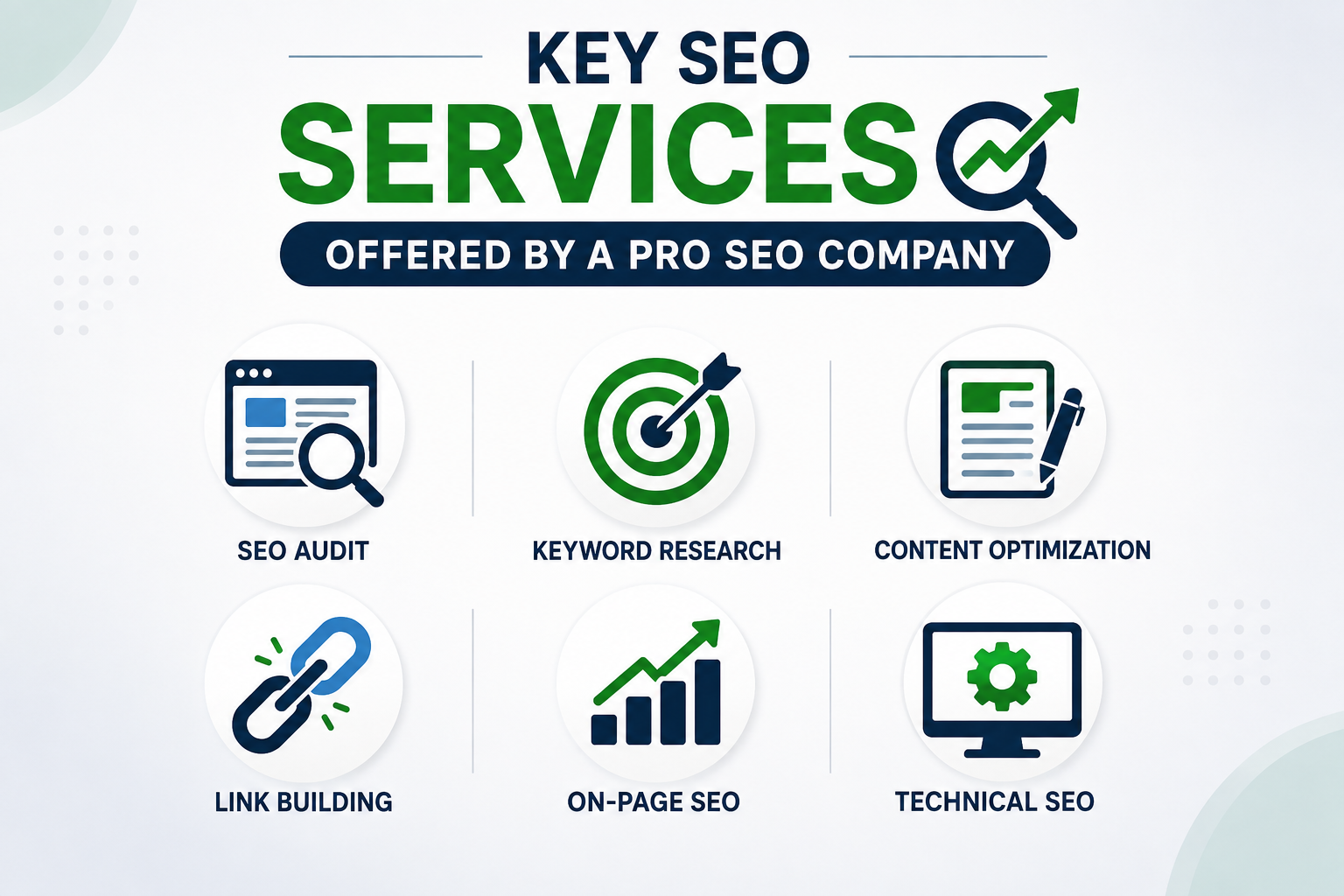
Search visibility does not happen by chance. If you want your website to attract qualified visitors, generate leads, and support long-term business growth, you need a structured SEO strategy that covers more than keywords. A professional SEO campaign combines technical improvements, useful content, authority building, local optimization, and continuous performance analysis.
A PRO SEO Company can bring these elements together into one coordinated strategy. Instead of applying the same tactics to every website, you can use professional SEO services to identify your specific challenges, understand your audience, and prioritize actions that support your business goals.
From technical SEO and keyword research to local SEO and AI-search optimization, here are the key services you should expect from a professional SEO partner.
Before you invest in SEO, you need to understand what is currently working and what is limiting your website.
A comprehensive SEO audit examines your website from technical, content, on-page, off-page, and user-experience perspectives. Your SEO provider may review:
The audit gives you a practical starting point. Instead of making random changes, you can prioritize high-impact problems and create an SEO roadmap based on evidence.
Keyword research helps you understand what your potential customers search for before they discover your business.
A professional SEO company does more than identify keywords with high search volume. It evaluates search intent, competition, relevance, business value, geographic modifiers, and the stage of the buyer journey.
For example, informational searches may indicate that someone is researching a problem, while transactional searches can show stronger purchase intent.
You can use keyword research to build a strategy around:
This approach helps you create pages that answer real customer needs instead of simply repeating keywords.
Your website needs to communicate clearly with both visitors and search engines. On-page SEO improves the elements users see and the signals search engines use to understand your pages.
A professional campaign can optimize your:
You should also focus on search intent. A page targeting a service keyword should explain the service, demonstrate expertise, address common concerns, and make the next step obvious.
Effective on-page SEO is not about keyword stuffing. It is about making every page relevant, useful, accessible, and easy to navigate.
Technical SEO creates the foundation for your website’s search performance. Even excellent content can struggle if search engines cannot properly crawl, understand, or index your pages.
A professional SEO team can identify technical issues involving:
You should treat technical SEO as an ongoing process rather than a one-time task. As your website grows, new pages, plugins, redirects, templates, and technical changes can introduce problems.
Regular monitoring helps you detect issues before they significantly affect organic visibility.
Content remains one of the most important parts of a successful SEO strategy. However, publishing large volumes of generic articles is unlikely to create sustainable results.
Your content should answer specific questions, demonstrate expertise, and provide genuine value.
A professional content strategy can include:
You should organize related content into logical topic clusters. A strong pillar page can cover a broad subject while supporting pages address specific questions and subtopics.
This structure can help users find related information while strengthening your site’s topical relevance.
If your business serves customers in specific cities, regions, or service areas, local SEO should be part of your strategy.
Local SEO helps you improve visibility for searches containing geographic intent, such as “SEO company near me” or “SEO services in [city].”
Professional local SEO services can include:
You should also make sure your business information remains consistent across important online directories and platforms. Accurate information improves customer confidence and supports local search visibility.
Your website’s authority is influenced by signals beyond your own pages. Off-page SEO focuses on strengthening your reputation across relevant websites and online platforms.
A professional link-building campaign may use:
Quality matters more than quantity. A smaller number of relevant, trustworthy backlinks can be more valuable than a large collection of low-quality links.
You should avoid manipulative link schemes and prioritize natural, relevant, and editorially appropriate links.
Search is becoming increasingly conversational. Users may now ask complete questions rather than entering short keyword phrases.
This makes Answer Engine Optimization (AEO) and Generative Engine Optimization (GEO) increasingly important.
Your SEO strategy should make information easy for search systems to understand, retrieve, and summarize. You can support this by:
You should also consider how your brand is represented across the wider web. Consistent business information, strong topical authority, expert content, and trustworthy mentions can help reinforce your digital entity.
Structured data gives search engines additional context about your website and its content.
Depending on your business, you may benefit from relevant schema types such as:
Schema should accurately represent the information visible on your page. It should never be used to add misleading or unsupported information.
When implemented correctly, structured data can help search engines interpret your content more efficiently and may make eligible pages suitable for enhanced search features.
SEO decisions should be based on measurable performance rather than assumptions.
Your SEO provider should monitor relevant metrics such as:
You should connect SEO metrics with actual business outcomes. Ranking for a keyword is useful, but generating qualified leads and revenue is often more important.
Regular reporting also helps you understand which strategies are producing results and where adjustments are needed.
Your competitors can reveal valuable opportunities. A professional SEO company can analyze competing websites to identify gaps in content, keywords, backlinks, technical performance, and local visibility.
You can use competitor analysis to discover:
The goal is not to copy competitors. Instead, you should understand the competitive landscape and create something more useful, comprehensive, and relevant.
Traffic alone does not guarantee business growth. Your website also needs to turn relevant visitors into leads, customers, bookings, or enquiries.
A conversion-focused SEO strategy connects search intent with clear user journeys.
You can improve conversions by using:
When SEO and conversion optimization work together, your organic traffic becomes more valuable.
You do not necessarily need every SEO service at the same intensity. Your priorities should depend on your website, industry, competition, target market, and business objectives.
Start by identifying your biggest opportunity. If your website has technical problems, address those first. If your technical foundation is strong but your content is weak, focus on keyword research and content development. If you serve a specific geographic market, strengthen local SEO.
A capable PRO SEO Company should explain why each recommendation matters, how it supports your goals, and how success will be measured.
You can also evaluate an SEO provider by looking for transparent reporting, realistic expectations, ethical practices, customized strategies, relevant experience, and consistent communication.
SEO combines technical knowledge, content strategy, user experience, authority building, analytics, and continuous adaptation. Managing all of these areas internally can become difficult as your website and competition grow.
Professional SEO services give you access to a structured process. You can identify problems, prioritize opportunities, implement improvements, measure outcomes, and refine your strategy over time.
The most effective approach is not focused solely on rankings. It focuses on making your website more useful to customers while making it easier for search engines and AI-powered systems to understand.
Your SEO strategy should reflect your business goals rather than follow a generic checklist. Whether you need stronger local visibility, better technical performance, more qualified traffic, or greater authority, the right combination of SEO services can help you build sustainable search visibility.
If you are ready to evaluate your website and identify your next SEO opportunities, use descriptive SEO consultation and contact options to begin a conversation with an experienced team.
A PRO SEO Company may provide technical SEO, keyword research, on-page optimization, content creation, local SEO, link building, competitor analysis, structured data, analytics, and AI-search optimization.
SEO usually requires consistent effort over time. The timeframe depends on your website’s authority, competition, technical condition, content quality, industry, and target keywords. Some improvements can appear relatively quickly, while competitive rankings generally require sustained optimization.
Yes. Local SEO can help businesses reach customers searching for nearby products or services. Optimizing your business profile, location pages, reviews, citations, and local content can strengthen visibility for geographically relevant searches.
Technical SEO helps search engines crawl, render, understand, and index your website. Problems such as slow pages, broken links, poor mobile usability, duplicate URLs, or incorrect indexing directives can make it harder for search engines to access and evaluate your content.
Look for transparent reporting, ethical SEO practices, relevant experience, customized strategies, clear communication, measurable objectives, and a focus on business outcomes rather than rankings alone.