

Voice Search SEO: Preparing Your Website for Conversational Queries
Mar 18, 2026


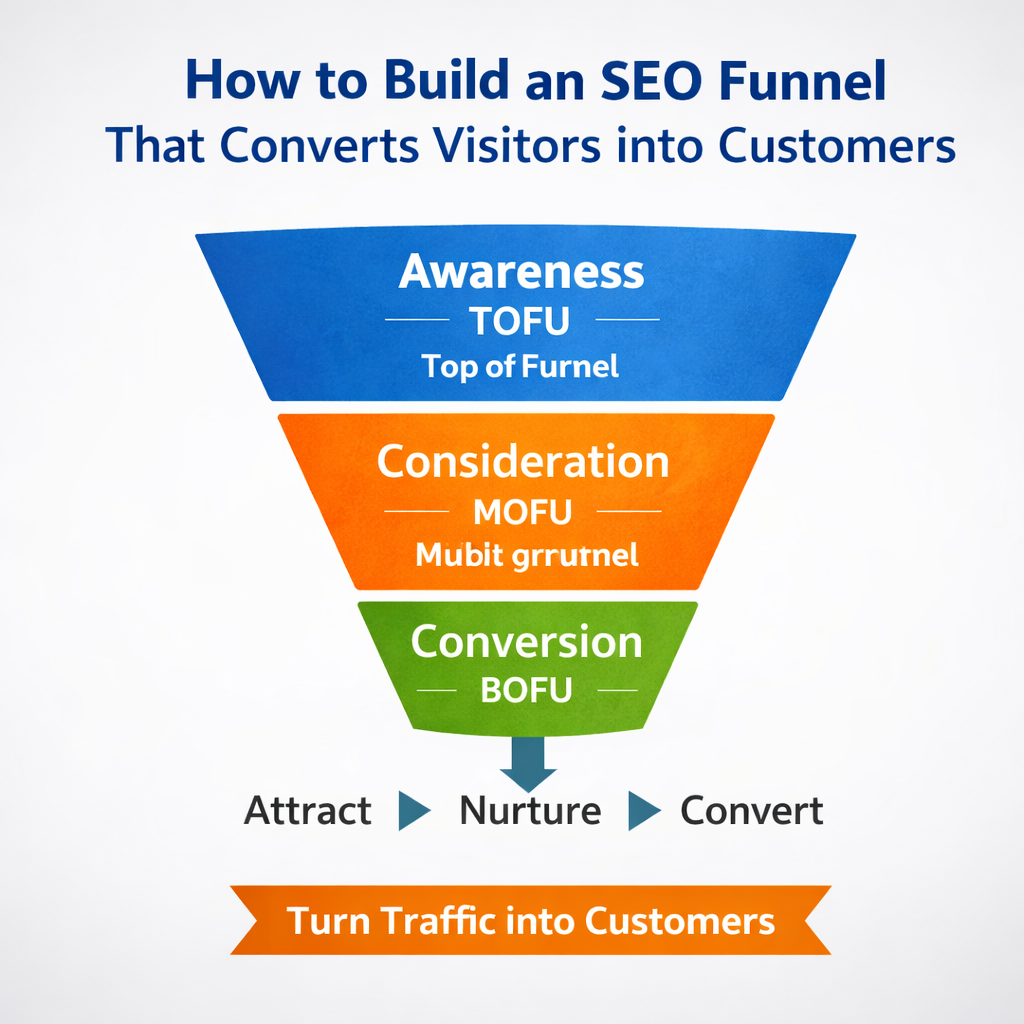
If you want to turn your website into a consistent source of leads and sales, you need more than rankings—you need a strategic SEO funnel. Instead of treating search engine optimization as a traffic game, you should view it as a customer journey. When done right, your SEO funnel guides visitors from awareness to decision, turning clicks into real business results.
In this guide, you’ll learn how to build an SEO funnel that not only attracts visitors but converts them into paying customers.
Before you start building, you need to understand what an SEO funnel looks like. It’s not just about keywords—it’s about intent.
Your funnel typically has three stages:
Each stage serves a different purpose. When you align your content and SEO strategy with these stages, you meet users exactly where they are in their journey.
You can’t build an effective funnel if you don’t understand why people are searching.
At the top of the funnel, users are looking for information. They may search for guides, tips, or definitions. At the middle stage, they compare options and look for solutions. At the bottom, they’re ready to take action.
Your job is to map keywords to each stage:
When you structure your SEO strategy around intent, you naturally move users down the funnel.
At the awareness stage, your goal is to attract the right audience—not just any traffic.
Focus on creating content that solves problems, answers questions, and builds trust. This includes:
Your tone should be helpful, not salesy. At this stage, you’re building authority and credibility.
For example, if you’re positioning yourself as a PRO SEO Company, your top-of-funnel content should demonstrate expertise in SEO fundamentals, trends, and strategies. This builds trust before you ever pitch your services.
Many businesses make the mistake of waiting until the bottom of the funnel to convert visitors. That’s too late.
Instead, you should capture leads at the top and middle stages using:
Offer something valuable in exchange for contact information. This allows you to nurture visitors even if they’re not ready to buy yet.
Make your calls-to-action clear but non-intrusive. You want to guide, not pressure.
Once you’ve attracted visitors, your next goal is to help them evaluate their options.
Middle-of-funnel content should focus on:
This is where you start positioning your solution as the best choice.
For example, you can create content that explains why working with a PRO SEO Company delivers better long-term results than DIY strategies. Show real outcomes, data, and examples.
At this stage, your content should answer the question: “Why should I choose you?”
An effective SEO funnel isn’t just about content—it’s about how that content connects.
Internal linking helps guide users from one stage to the next. For example:
This creates a natural flow through your website.
Think of your internal links as signposts. They should always point users toward the next logical step in their journey.
At the bottom of the funnel, your visitors are ready to take action. Now your focus shifts from education to conversion.
Your BOFU content includes:
These pages should be optimized for both SEO and conversions.
Key elements to include:
For example, a well-placed Contact Us call-to-action can make it easy for potential customers to reach out when they’re ready to move forward.
Keep your messaging focused and persuasive. Remove distractions and guide users toward a single action.
Calls-to-action (CTAs) are critical in moving users through your funnel.
Instead of generic phrases, use descriptive, intent-driven CTAs like:
Make sure your CTAs align with the content stage. A TOFU article shouldn’t push for a sale—it should encourage the next step.
Strategically place your CTAs throughout your content without overwhelming the reader.
Your funnel won’t work if your content doesn’t rank.
Make sure every piece of content is optimized with:
SEO isn’t just about visibility—it’s about user experience. The better your pages perform, the more likely users are to stay and convert.
Trust is what turns visitors into customers.
You can build trust by including:
When users see proof that your strategies work, they’re more likely to move forward.
For example, showcasing successful campaigns handled by your PRO SEO Company can significantly increase confidence in your services.
An SEO funnel is never “done.” You need to continuously measure and improve.
Track key metrics such as:
Identify where users drop off and optimize those areas.
For example:
Data-driven decisions will help you refine your funnel over time.
One of the biggest mistakes you can make is creating disconnected content.
Every piece of content should serve a purpose within your funnel.
Ask yourself:
When your content works together, it creates a seamless experience that guides users toward conversion.
Building an SEO funnel isn’t a one-time effort—it’s an ongoing strategy.
You need to consistently:
Consistency builds momentum. Over time, your funnel becomes more effective and generates better results.
If you want to turn your SEO efforts into real business growth, you need a funnel—not just rankings.
By understanding search intent, creating stage-specific content, and guiding users with strategic CTAs, you can transform your website into a conversion engine.
Start by building awareness with valuable content, nurture your audience with insights and proof, and close the deal with optimized landing pages.
When you approach SEO as a journey instead of a tactic, you’ll not only attract visitors—you’ll convert them into loyal customers.
1. What is an SEO funnel?
An SEO funnel is a structured strategy that guides users from awareness to conversion through search-optimized content. It aligns content with user intent at each stage to turn organic traffic into leads and customers.
2. Why is search intent important in an SEO funnel?
Search intent helps you understand what users want at each stage. By matching content to intent, you deliver relevant information, improve engagement, and increase the chances of moving users toward conversion.
3. What type of content works best for each funnel stage?
TOFU uses educational content, MOFU focuses on comparisons and case studies, and BOFU includes service pages and offers. Each type is designed to guide users closer to making a decision.
4. How do internal links support an SEO funnel?
Internal links connect related content and guide users through the funnel stages. They improve navigation, boost SEO performance, and encourage visitors to take the next step in their journey.
5. How can I improve conversions in my SEO funnel?
Improve conversions by using clear CTAs, optimizing landing pages, adding social proof, and aligning content with user intent. Regularly analyze performance data to identify and fix drop-off points.