• X Twitter
Apr 1, 2026

Content Clusters vs. Traditional Blogging: What Works Better for SEO?

If you want to improve your search rankings and drive consistent organic traffic, you’ve likely come across two major strategies: traditional blogging and content clusters. While both approaches can help you grow your online presence, they differ significantly in structure, scalability, and long-term SEO impact.

Understanding how each works—and when to use them—can help you build a smarter, more effective content strategy. Instead of guessing what might work, you can align your efforts with how modern search engines evaluate content today.

Let’s break down both methods and help you decide what works better for your SEO goals.

What Is Traditional Blogging?

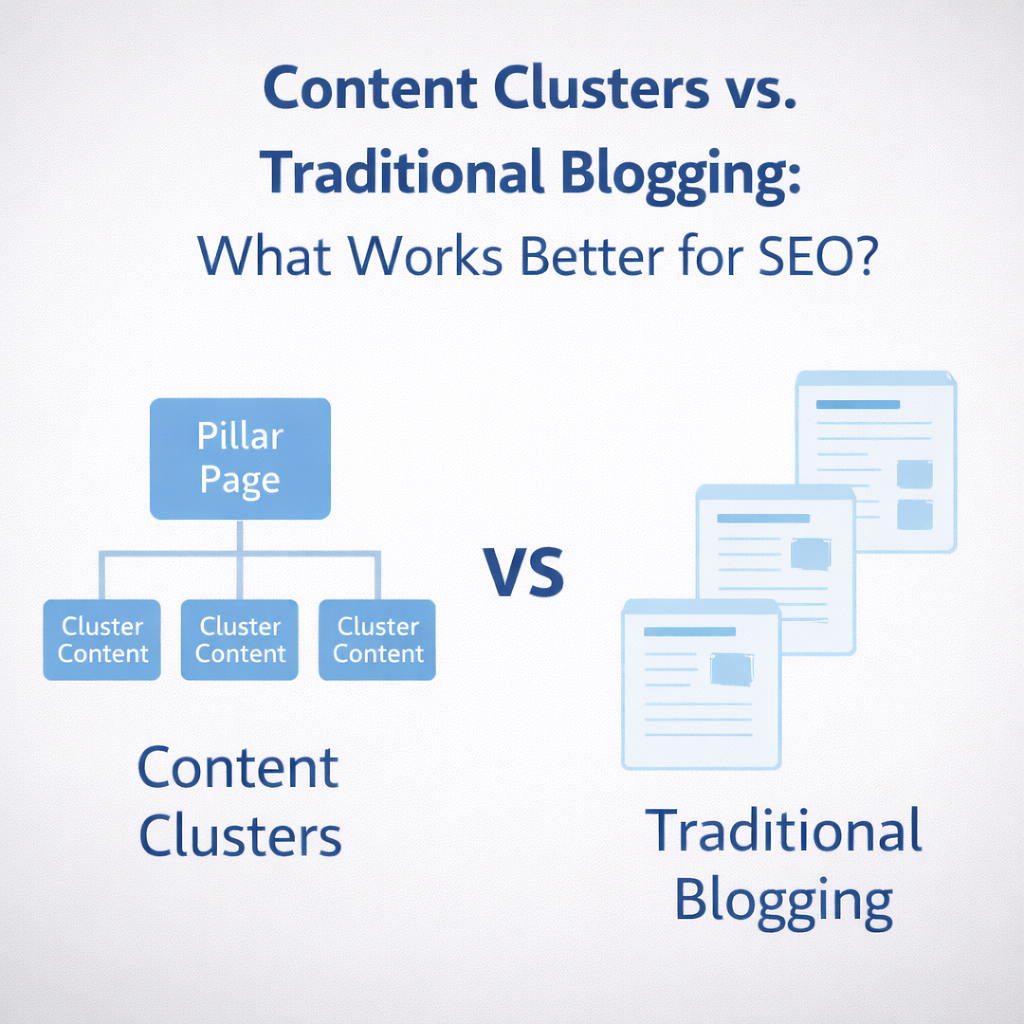
Traditional blogging is the approach most websites started with. You create individual blog posts targeting specific keywords, publish them regularly, and hope they rank in search engines.

Each post usually focuses on a single topic, with minimal connection to other articles on your site. Over time, you build a library of content, but it often lacks a clear structure.

Key characteristics of traditional blogging:

  • Independent articles targeting isolated keywords
  • Minimal internal linking strategy
  • Content published based on trends or ideas
  • Limited topical depth across related subjects

While this method can still generate traffic, it has become less effective in highly competitive niches.

What Are Content Clusters?

Content clusters are a more strategic approach to organizing your content. Instead of publishing random blog posts, you create a central “pillar” page that covers a broad topic, then support it with multiple related articles (cluster content).

Each cluster article links back to the pillar page, and the pillar links out to each supporting piece. This creates a strong internal linking structure that signals authority to search engines.

Key characteristics of content clusters:

  • A pillar page targeting a broad keyword
  • Multiple supporting articles targeting subtopics
  • Strong internal linking between all pieces
  • Focus on building topical authority

This structure aligns closely with how search engines understand content relevance and expertise.

How Search Engines Evaluate Content Today

Search engines have evolved. They no longer rank pages based solely on keywords. Instead, they evaluate:

  • Topic depth
  • Content relationships
  • User intent satisfaction
  • Authority within a subject area

If your content is scattered and disconnected, it becomes harder for search engines to understand your expertise. Content clusters solve this by organizing your site into clear topic ecosystems.

SEO Benefits of Traditional Blogging

Traditional blogging still has its advantages, especially if you’re just starting out.

  1. Simplicity
    You can quickly create and publish content without worrying about structure.
  2. Flexibility
    You can cover a wide range of topics without committing to a specific niche.
  3. Speed
    It’s faster to produce individual blog posts than to build a full content cluster.

However, these benefits come with limitations.

Limitations of Traditional Blogging

If you rely only on traditional blogging, you may face several challenges:

  1. Weak Topical Authority
    Publishing random posts doesn’t establish you as an expert in a specific subject.
  2. Poor Internal Linking
    Without a structured approach, your content remains disconnected.
  3. Keyword Cannibalization
    Multiple posts may compete for similar keywords, hurting your rankings.
  4. Slower SEO Growth
    Search engines struggle to see the bigger picture of your expertise.

SEO Benefits of Content Clusters

Content clusters address many of these issues and offer a more advanced SEO strategy.

  1. Strong Topical Authority
    When you cover a subject in depth, you position your site as a trusted resource.
  2. Improved Rankings
    Internal linking distributes authority across all related pages, boosting visibility.
  3. Better User Experience
    Visitors can easily navigate through related content, increasing engagement.
  4. Higher Organic Traffic
    Ranking for multiple related keywords drives more consistent traffic.
  5. Future-Proof Strategy
    Content clusters align with how search engines continue to evolve.

Why Content Clusters Work Better for SEO

If your goal is long-term growth, content clusters outperform traditional blogging in several ways.

  1. They Match Search Intent More Effectively
    Instead of targeting isolated keywords, you cover entire topics. This helps you meet different stages of user intent—from awareness to decision-making.
  2. They Build Authority Faster
    Search engines recognize when your content consistently covers a subject in depth.
  3. They Improve Crawlability
    Internal links help search engines discover and index your content more efficiently.
  4. They Reduce Content Gaps
    By planning clusters, you ensure you’re not missing important subtopic

When Traditional Blogging Still Makes Sense

Despite its limitations, traditional blogging isn’t completely obsolete. It works well in certain situations:

  • When testing new content ideas
  • When covering trending or time-sensitive topics
  • When building initial website content
  • When resources are limited

However, relying on it as your primary strategy can limit your SEO potential.

How to Transition to a Content Cluster Strategy

If you’ve been using traditional blogging, you don’t need to start from scratch. You can transform your existing content into clusters.

Step 1: Identify Core Topics
Choose broad subjects that are relevant to your business and audience.

Step 2: Create Pillar Pages
Develop comprehensive guides that cover each topic in detail.

Step 3: Organize Existing Content
Group related blog posts and connect them to your pillar pages.

Step 4: Fill Content Gaps
Create new articles to cover missing subtopics.

Step 5: Strengthen Internal Links
Ensure every cluster page links back to the pillar and vice versa.

Common Mistakes to Avoid

When implementing content clusters, avoid these pitfalls:

  1. Choosing Topics That Are Too Broad
    If your pillar topic is too general, it becomes difficult to cover effectively.
  2. Ignoring Internal Linking
    Without proper linking, your cluster loses its SEO value.
  3. Publishing Low-Quality Content
    Depth and quality matter more than quantity.
  4. Not Updating Old Content
    Your cluster should evolve as new information becomes available.

Combining Both Strategies for Maximum Impact

The best approach isn’t always choosing one over the other—it’s knowing how to combine them.

You can use traditional blogging for:

  • Quick content opportunities
  • Industry updates
  • Experimental topics

And use content clusters for:

  • Core business topics
  • Evergreen content
  • Long-term SEO growth

This hybrid strategy gives you flexibility while maintaining a strong foundation.

How You Can Get Started Today

If you want to improve your SEO performance, start small but think strategically.

  • Choose one key topic
  • Build a strong pillar page
  • Create 5–10 supporting articles
  • Link everything together

Over time, expand your clusters and refine your structure.

If you’re unsure how to implement this effectively, working with a professional team can make a significant difference. A trusted PRO SEO Company can help you design and execute a content strategy that delivers measurable results.

And when you’re ready to take the next step, don’t hesitate to Contact Us to explore how you can scale your SEO efforts with a smarter, more structured approach.

Final Thoughts

Content clusters and traditional blogging both have their place in SEO, but they are not equal in impact.

Traditional blogging offers simplicity and speed, but lacks structure and long-term scalability. Content clusters, on the other hand, provide a powerful framework for building authority, improving rankings, and driving consistent traffic.

If you want to stay competitive in modern search, you need more than just content—you need strategy. By focusing on content clusters, you create a system that works with search engines, not against them.

The sooner you make the shift, the faster you’ll see meaningful, lasting results.

Frequently Asked Questions (FAQs)

  1. What is the main difference between content clusters and traditional blogging?
    Content clusters focus on structured, interconnected content around a central topic, while traditional blogging involves standalone posts. Clusters build stronger topical authority, whereas traditional blogging often lacks clear organization and depth.
  2. Which strategy is better for SEO: content clusters or traditional blogging?
    Content clusters generally perform better for SEO because they improve internal linking, enhance topical authority, and align with how search engines evaluate content relevance and expertise.
  3. Can I combine content clusters with traditional blogging?
    Yes, combining both strategies is effective. Use content clusters for core topics and long-term growth, while traditional blogging can cover trends, updates, and experimental content.
  4. How do content clusters improve search rankings?
    They create a clear content structure, strengthen internal linking, and cover topics comprehensively. This helps search engines understand your expertise, leading to higher rankings across multiple related keywords.
  5. Do I need to create new content to build clusters?
    Not always. You can reorganize existing blog posts into clusters, link them to a pillar page, and add new content only to fill gaps or improve topic coverage.